
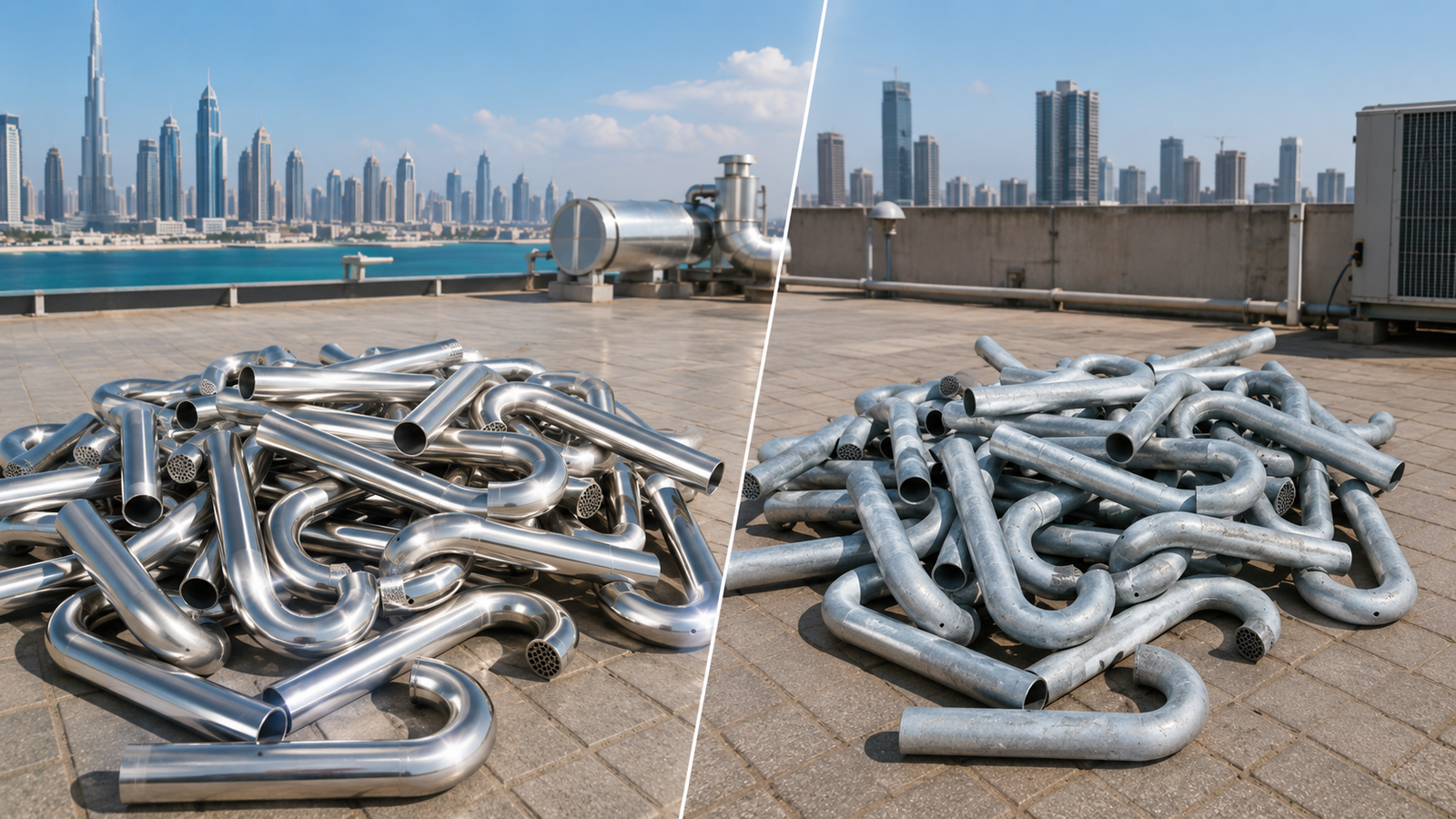
The choice of air vent material is not only important from the standpoint of technical specifications but also impacts the durability of the ventilation system, its future maintenance cost, and its ability to withstand Dubai’s weather and climate conditions. Two major options here are the usage of stainless steel vs, galvanized iron (GI). Each of these materials has its own pros that depend on application conditions.
Below is a simple table comparing these materials.
What’s the Difference Between Stainless Steel and GI Air Vents?
Stainless steel air vents are made of an alloy containing chromium, which forms a thin, self-healing oxide layer on the surface. This layer is what gives stainless steel its resistance to rust and corrosion, even in demanding environments.
GI air vents are made from ordinary steel that has been coated with a layer of zinc through a galvanization process. The zinc coating acts as a sacrificial barrier that rusts first, protecting the steel underneath, but only for as long as the coating lasts.
Both materials do the same basic job of controlling airflow, releasing pressure, or venting exhaust, but they perform very differently over time, especially in the UAE’s climate.
Corrosion Resistance — Critical for UAE’s Climate
This is usually the deciding factor for projects in Dubai and across the UAE.
- Stainless steel holds up well against humidity, salt-laden air, and general moisture exposure. Its corrosion resistance doesn’t rely on a coating, so there’s nothing to wear away over time. This makes it a strong choice for coastal buildings, marine facilities, and any structure near the sea.
- GI vents perform fine in drier, lower-humidity conditions, but the zinc coating degrades faster in coastal or high-humidity environments. Once the coating wears through, the underlying steel is exposed and corrosion can set in quickly.
If your project is near the coast, involves marine or industrial exposure, or needs to withstand years of UAE summers without intervention, stainless steel has a clear edge here.
Cost Comparison: Upfront Price vs. Long-Term Value
| Factor | Stainless Steel | GI |
| Upfront cost | Higher | Lower |
| Maintenance needs | Minimal | Recoating/replacement over time |
| Expected lifespan | Long | Shorter, especially in humid/coastal areas |
| Total cost of ownership | Often lower over time | Can add up with repairs/replacement |
GI air vents are the more budget-friendly option at the point of purchase, which makes them attractive for projects with tighter upfront costs. But if you factor in maintenance, potential recoating, and earlier replacement, stainless steel often works out more economically over the full life of the building — particularly for long-term or high-exposure installations.
Durability & Lifespan
In UAE conditions — high heat, humidity, and dust — the gap in durability between the two materials becomes more noticeable over time.
- Stainless steel typically holds up for decades with little to no maintenance, even in demanding environments.
- GI vents can perform well for a good number of years in low-exposure settings, but heat and humidity accelerate wear on the zinc coating, meaning shorter service life and a higher chance of needing recoating or replacement sooner than expected.
If the air vent is going somewhere hard to access — a rooftop, a high wall, or an industrial installation — the lower-maintenance option is usually worth the extra upfront cost.
Best Applications for Each
Stainless steel air vents work best for:
- Marine environments and coastal buildings
- Food processing and pharmaceutical facilities (hygiene-sensitive settings)
- High-spec commercial and industrial buildings
- Projects where long-term durability outweighs upfront cost
GI air vents work best for:
- Budget-conscious residential and commercial projects
- Indoor or low-exposure ventilation applications
- Temporary or short-term installations
- Projects in drier, less corrosive environments
Not sure which material suits your project? Flow Tech Trading FZ-LLC supplies both stainless steel and GI air vents fabricated to spec for projects across the UAE — get in touch to match the right material to your site conditions.
FAQs
Does stainless steel air vent rust?
Stainless steel is highly resistant to rust due to its chromium content, which forms a protective oxide layer. It won’t rust the way regular steel does, though very low-grade stainless steel can show surface staining in extreme conditions.
How long do GI air vents last in Dubai’s climate?
It varies with exposure, but the zinc coating on GI vents tends to wear down faster in Dubai’s heat and humidity compared to drier climates, especially in coastal or industrial areas. Indoor or low-exposure installations will last considerably longer than outdoor, coastal ones.
Which is better for rooftop installations?
Stainless steel is generally the better choice for rooftops, since it’s exposed to direct sun, heat, and weather year-round without the option for easy recoating or maintenance.
Are stainless steel air vents worth the extra cost?
For long-term installations, coastal projects, or hard-to-maintain locations, yes — the reduced maintenance and longer lifespan typically offset the higher upfront price. For short-term or low-exposure indoor use, GI may be the more practical choice.