
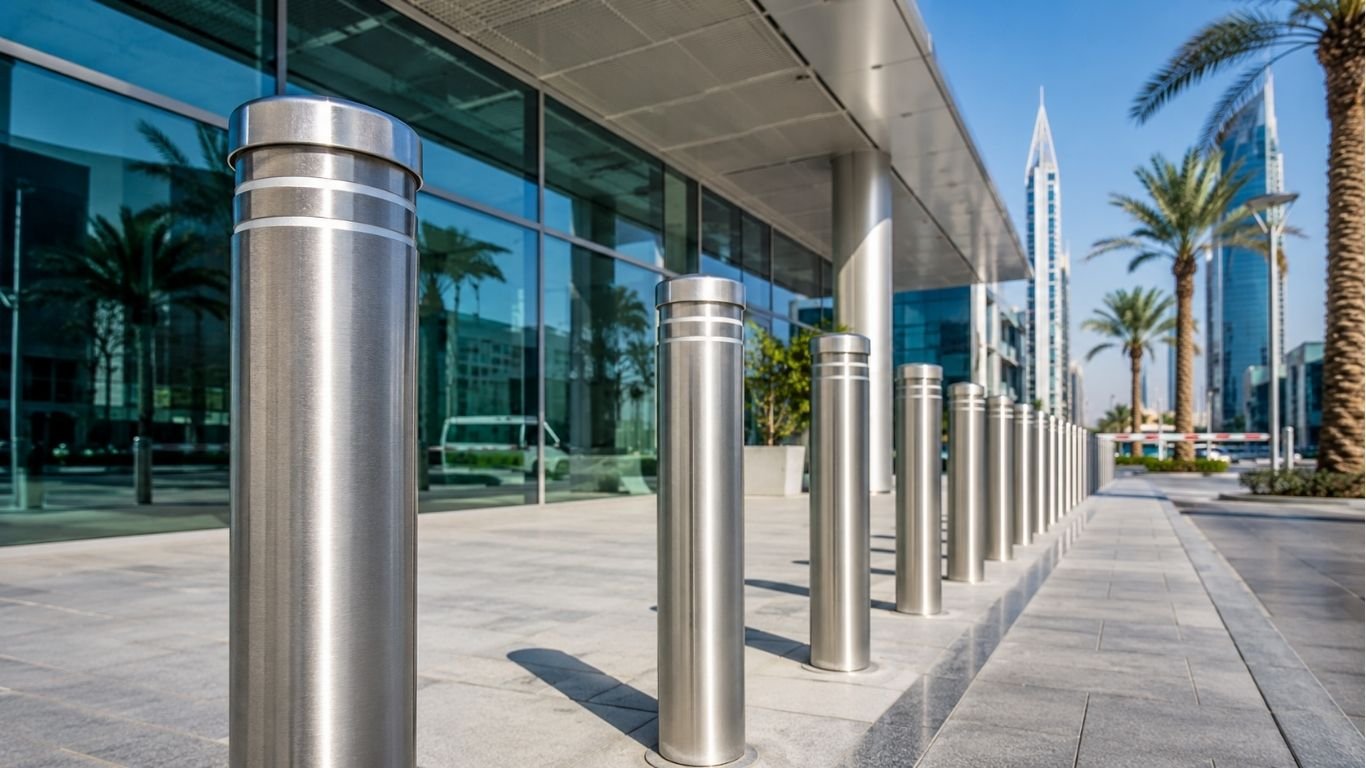
If you have seen how a row of rusty metal bollards can get orange in just one summer near the Gulf coast, then you know what is being solved here. Correct material selection is not just an option – it is the difference between 15 years of operation and the need to replace them every 18 months. The only type of Stainless Steel Bollards in UAE projects almost always is Grade 316.
It is not some kind of marketing consideration – this is the property of steel, which was selected based on the harsh combination of hot, humid, salty and dusty air that characterizes UAE. In this guide, we will discuss what sets Grade 316 apart from other types of stainless steel, why it is durable and what you should look for when selecting bollards for your project.
What Makes Stainless Steel 316 Different?
In a nutshell, the main feature that makes Grade 316 stainless steel unique is the presence of molybdenum (usually 2-3%) that increases its chloride and saltwater resistance to a greater extent than that of the same type without this alloying element or ordinary carbon steel, like 304 grade
It should be noted that stainless steel itself is not one particular material, but rather a group of materials. Grade 304 is the most widespread type of stainless steel. Its applications include kitchen countertops and interior railings. The thing that differentiates 316 from 304 and regular carbon steel is the addition of molybdenum.
Here is a simple explanation of the difference: 304 stainless steel is resistant to rust; 316 is resistant to both rust and chloride-induced pitting. This feature becomes especially significant when considering a product to be used in an environment of a coastal city such as Dubai, Abu Dhabi, or Sharjah.
Chemical Composition That Matters
| Property | Grade 304 | Grade 316 |
| Chromium | 18–20% | 16–18% |
| Nickel | 8–10.5% | 10–14% |
| Molybdenum | None | 2–3% |
| Chloride resistance | Moderate | High |
| Ideal environment | Indoor, dry | Coastal, humid, industrial |
Why Stainless Steel Bollards in UAE Need Grade 316
It’s not simply the heat; it’s more than one factor that the material used must endure to maintain its longevity in the UAE. Knowing what conditions prevail in this region would help understand why all reputable bollard suppliers who supply grade 316 stainless steel bollards in UAE insist on it over low-grade materials.
1. High Humidity and Salt-Laden Coastal Air
Major cities such as Dubai, Sharjah, and Ras Al Khaimah have direct access to the coastline of the Gulf of Oman. As salt particles from the sea breezes settle on the exposed metal surfaces, they begin attacking the oxide layer that keeps the stainless steel stainless in a short span of time. Grade 304 stainless steel starts forming pits of corrosion after a few years. Grade 316, however, resists it for much longer due to its increased molybdenum content.
2. Extreme Heat and UV Exposure
Metal surfaces in Dubai during summer can get extremely hot, going well above ambient temperature – sometimes up to 60 degrees Celsius. Continuous heating and cooling put pressure on metal’s integrity and on any protective paint used on the metal’s surface. Grade 316 metal does not corrode and remains mechanically strong over a much larger temperature range compared to the mild steel painted or lower grades of metal.
3. Dust, Sand and Abrasion
Dust in desert is not merely superficial dust but an abrasive that in presence of moisture accelerates surface degradation. The bollards installed near shopping malls’ entrances, parking facilities and pedestrian paths will experience continuous light abrasion due to footfalls, proximity to the cars and sand blowing in the wind. A robust surface of grade 316 stainless steel will retain its polish much longer than any powder coated or galvanized steel.
4. Chemical Exposure in Industrial & Coastal Areas
Outdoor fixtures in industrial areas in Jebel Ali, Dubai Investment Park, and elsewhere are likely to come into contact with chemical runoff, cleaning solutions, and exhaust from automobiles. The resistance of Grade 316 not only includes salt but other chemicals as well, making it a better investment for industrial estates, warehouses, and logistics facilities.
Key Benefits of Stainless Steel 316 Bollards
Simply stated, this is what you get when you specify 316 over other, less expensive grades:
- Superior corrosion resistance – molybdenum gives 316 resistance to chloride-induced pitting that is superior to 304 or carbon steel
- Increased lifespan – properly maintained 316 bollards can last for 15–20+ years in coastal conditions in UAE
- Reduced total cost of ownership – fewer replacements and painting costs outweigh the increased initial cost of the materials
- Improved aesthetics – maintains polished/brushed surface without streaks and discoloration found on inferior grades
- Minimal maintenance needs – usually limited to periodic cleaning, without the need for painting or repainting
- Dependable structural integrity – maintains impact and strength resistance despite thermal cycling
- Design flexibility – can be ordered as fixed/removable/telescopic/brightened without sacrificing corrosion resistance
316 vs 304: A Practical Comparison
| Factor | Grade 316 | Grade 304 |
| Best suited for | Coastal, humid, chemically exposed areas | Dry, indoor, low-humidity settings |
| Corrosion resistance | Excellent | Good, but limited in salt exposure |
| Upfront cost | Higher | Lower |
| Long-term cost (UAE climate) | Lower (fewer replacements) | Higher (frequent maintenance/replacement) |
| Recommended UAE use | Outdoor bollards, marinas, entrances, industrial zones | Indoor fixtures, low-exposure interior applications |
If your bollards will be anywhere that’s exposed to salt air, sprinkler spray, or sunlight most of the time, 316 makes more sense long-term, despite its higher initial cost per bollard.
Common Pitfalls to Avoid When Selecting Bollards for UAE Projects
1. Confusing “stainless steel” with a specific grade
Some sellers sell bollards that are simply labeled stainless, when what you want is either 304 or 316. It pays to ask.
2. Valuing upfront cost over lifecycle cost
Sometimes it turns out to be more expensive to install multiple 304 bollards over a decade than it would be to buy 316 bollards at once.
3. Not considering surface quality
The proper steel grade isn’t enough – poor quality finishing or improper welding leaves weak spots where corrosion will begin.
4. Overlooking wall thickness and diameter
Grading is important, but not the whole story. Thinner walls on 316 bollards may dent and deform easily under impact unless the specification fits the project.
5. Neglecting proper fixing of the base
High-quality steel alone won’t last if the bollards are not fixed well into place. Fixing methods must correspond to soil and traffic conditions.
Best Practices for Long-Term Bollard Performance
- Use Grade 316 for any outdoor, coastal, or moisture-prone application in Dubai, Sharjah, or Ras Al Khaimah
- Select a brushed satin finish for areas where people congregate because it covers small scratches better than mirror polishing
- Ensure that wall thickness is appropriate for its use — a pedestrian guidance system requires less fortification than impact protection
- Have all welding and fabrication information provided by your supplier, not guessed at
- Wash bollards using chloride-free cleaners to maintain the passive oxide film
- Work with an expert fabricator familiar with the specific environmental stresses in the UAE, not an overseas cataloguer
Where 316 Stainless Steel Bollards Are Typically Used
Grade 316 stainless steel bollards find applications in many locations in UAE, such as:
- Mall entrances
- Office building driveway entrance areas
- Parking areas and multilevel parking structures
- Walkways and park areas
- Marina and waterfront areas and beachfront properties
- Logistics centers and industrial warehouses
- Government offices and embassies
The traffic loading and exposure levels vary for each location, which is why there is a need for various types of bollards, such as fixed, removable, telescopic, and illuminated bollards.
Future Trends in Bollard Design and Material Selection
With the ongoing growth of UAE infrastructure towards smart city criteria, the design of bollards is also changing. One should expect to witness an increasing use of built-in LED lighting for improved visibility at night, automated bollards that would respond to sensors for controlled access points, and focus on corrosion resistant materials as sustainable development becomes a priority over purchasing of cheapest upfront solutions. Grade 316 nicely aligns with these trends.
How to Choose a Supplier for Stainless Steel Bollards in UAE
While grade is important, the other aspect that needs consideration is the quality of the fabrication process. If you are selecting Stainless Steel bollards in UAE settings, it is necessary to find a supplier that can guarantee the grade certification, can customize according to requirements for either fixed, portable or illuminated versions and has prior experience of installation in various settings within Dubai, Sharjah, and Ras Al Khaimah.
Flow Tech Dubai manufactures bollards in certified Grade 316 stainless steel designed for UAE environments, through quality assurance measures and delivery throughout the UAE. In case you have plans of setting up any kind of projects whether commercial, industrial or public places, then it would be useful to ask for a consultancy session in order to select the bollard specifications according to the environment.
Conclusion
The factors of high temperature, high humidity levels, and salts present in the air are the very reason why the choice of materials plays such a vital role in all outdoor fixtures installed in UAE. Although it is always tempting to choose cheaper alloys, they would not be able to withstand the harsh Gulf environment without suffering some degree of corrosion or deterioration in structural integrity. This is why the material used for manufacturing Stainless Steel bollards in UAE installations is mainly Grade 316 – just because it was designed specifically for such environments.
FAQ
1. Why is Grade 316 stainless steel more suitable than Grade 304 for UAE bollards?
Grade 316 stainless steel includes molybdenum in its chemical composition, hence making it highly resistant to chloride-induced corrosion due to saline and humidity. The use of 316 is thus much preferred compared to 304 in coastal UAE towns where it will have a longer life-span than grade 304, which is suitable for dry interior locations.
2. How long do Stainless Steel 316 bollards last in the UAE?
In normal fabrication and installation conditions, Grade 316 bollards are expected to last 15-20 years or more. The exact lifespan of a bollard depends on several factors including its maintenance, traffic exposure and proximity to industrial areas and coastlines.
3. Are Stainless Steel 316 bollards expensive?
Yes, the initial cost of the material used in manufacturing such bollards is more costly compared to Grade 304 and mild steel. However, in the long-run, the lower costs of maintenance and replacements make Grade 316 more economical.
4. Are Stainless Steel 316 bollards customizable for various projects?
Yes. Stainless steel grade 316 bollards can be designed as either fixed, retractable, telescopic, or illuminated depending on the purpose, diameter, height, and finishing required.
5. Should Stainless Steel bollards in UAE undergo frequent maintenance?
Maintenance frequency is relatively low compared to painted or galvanized ones. Cleaning using mild substances that do not contain abrasive particles and chlorides will maintain the bollard’s finish in top condition for years to come.
6. Where should Stainless Steel 316 bollards be used in the UAE?
Grade 316 is ideal for use in any outside area especially in regions with high humidity, presence of salts or chemicals.