
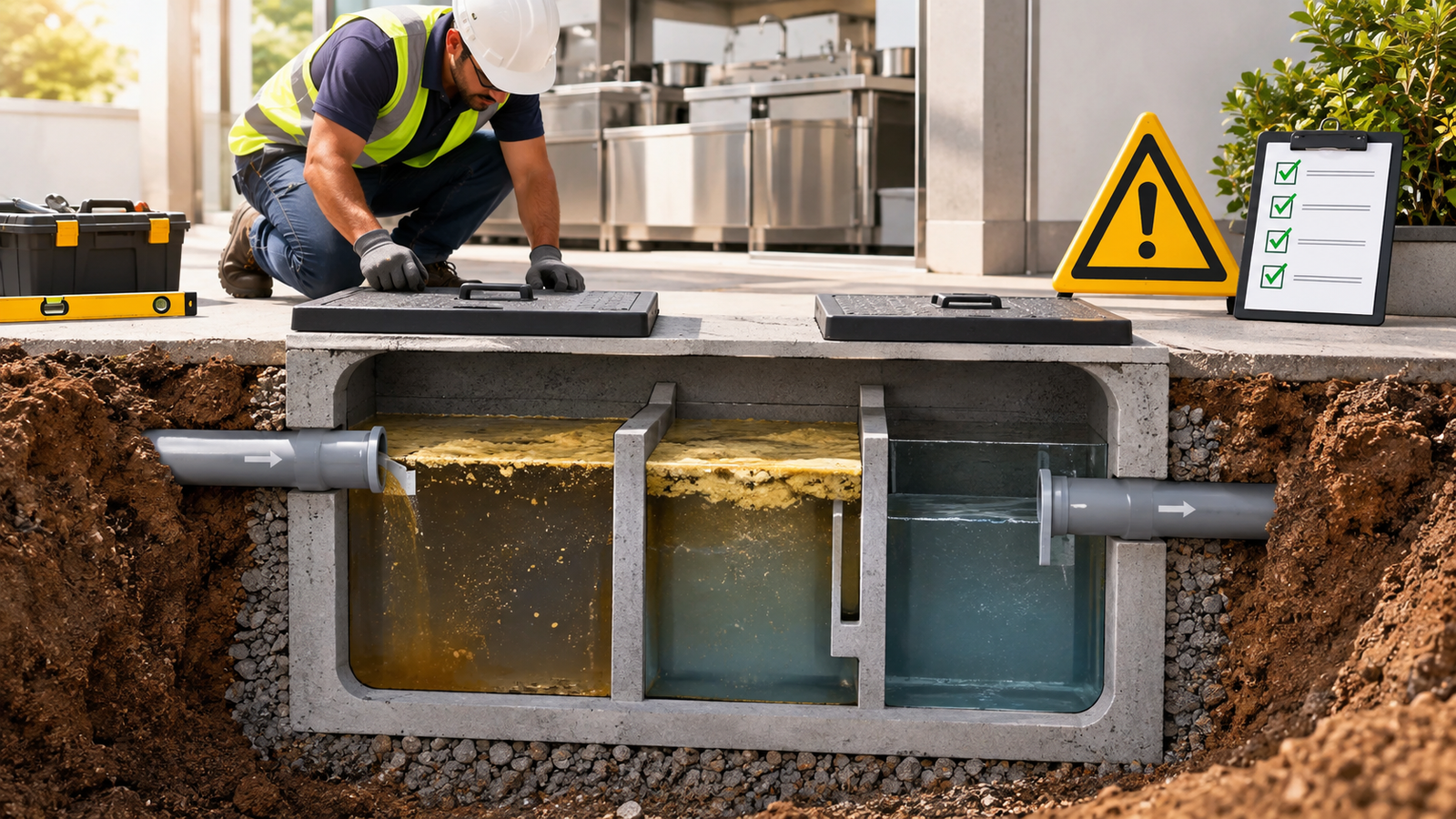
Restaurants, hotels, commercial kitchens, food processing plants, and other establishments that release fats, oils, and grease (FOG) into drainage systems must have a grease trap installed correctly. By separating grease from wastewater before it enters drainage pipes, a well-designed grease trap helps prevent blockages, offensive odors, and expensive maintenance.
However, improper sizing, placement, or installation can cause even a high-quality grease trap to work badly. Understanding common grease trap installation mistakes can help businesses, contractors, and MEP professionals achieve better drainage performance and longer service life.
1. Choosing the Wrong Grease Trap Size
One of the most common mistakes is selecting a grease trap based only on price or available space. While an overly big unit can raise installation and maintenance expenses, an undersized grease trap might not be able to separate grease efficiently.
The number of sinks, fixtures, meals served, wastewater volume, commercial kitchen type, and kitchen flow rate should all be taken into account when determining the ideal size.
How to avoid it: Consult a qualified grease trap supplier and select the capacity according to the actual application and project requirements.
2. Installing the Grease Trap in the Wrong Location
Grease trap maintenance requires accessibility. Installing a unit in a difficult-to-reach area can make inspection, cleaning, and grease removal unnecessarily complicated.
In addition to offering sufficient access for maintenance, the location should permit appropriate connections to the kitchen drainage system.
How to avoid it: During the drainage design phase, plan the position of the grease trap and make sure there is sufficient space for cleaning and inspection.
3. Incorrect Pipe Connections
Grease separation efficiency might be decreased, and wastewater flow can be impacted by misaligned inlet and exit pipes. Leaks and clogs can also be made more likely by improper slopes, loose connections, or inappropriate fittings.
How to prevent it: Make sure pipe connections, gradients, and fittings are inspected prior to system activation and adhere to the manufacturer’s installation specifications.
4. Ignoring Ventilation Requirements
As a component of a drainage system, a grease trap needs proper ventilation to facilitate efficient wastewater movement and aid in the control of gases and odors.
Slow drainage, offensive odors, and pressure-related problems can all be caused by inadequate ventilation.
How to prevent it: Instead of considering the grease trap as a separate item, incorporate appropriate drainage ventilation into the overall plumbing design.
5. Using Incompatible or Poor-Quality Materials
Commercial kitchens work in harsh conditions where drainage components may be impacted by grease, hot wastewater, cleaning products, and moisture. The installation’s service life may be shortened by using inappropriate materials.
How to prevent it: Select materials based on the project parameters, wastewater characteristics, and application. Prior to installation, quality manufacturing and material compatibility should be taken into account.
6. Forgetting Maintenance Access
Even the best grease trap requires regular inspection and cleaning. Placing the unit so that maintenance staff cannot readily access the cover or interior components is a common installation error.
How to prevent it: Include maintenance requirements in the initial installation plan and keep access points clear.
Why Choose Flow Tech for Grease Trap Solutions?
In the UAE, Flow Tech Trading FZ-LLC supports commercial, industrial, and construction projects with manufactured building materials and grease trap solutions. We provide UPVC fabrication and installation services in addition to several grease trap types, such as Type A, Type B, and Type C.
In addition, Flow Tech offers technical assistance and site visits to assist contractors, project managers, and companies in choosing solutions based on their project specifications. Our operational presence across Dubai, Sharjah, Ras Al Khaimah, and Ajman supports projects across multiple UAE locations.
Conclusion
Installing a grease trap correctly is just as crucial as selecting a high-quality product. System performance can be greatly enhanced by appropriate sizing, placement, precise pipe connections, ventilation, compatible materials, and easy maintenance access.
Working with a skilled grease trap supplier in the UAE can assist restaurants, hotels, commercial kitchens, and industrial facilities in avoiding installation issues and promoting a more dependable drainage system. To satisfy various project needs, Flow Tech offers grease trap products, fabrication, installation, and technical support.
FAQs
1. What is the most common grease trap installation mistake?
Choosing the wrong grease trap size is one of the most common mistakes and can reduce grease separation efficiency.
2. Where should a grease trap be installed?
A grease trap should be installed in an accessible location with proper drainage connections and enough space for cleaning and maintenance.
3. How often should a grease trap be cleaned?
Cleaning frequency depends on kitchen usage and grease accumulation. Regular inspection helps determine the appropriate cleaning schedule.